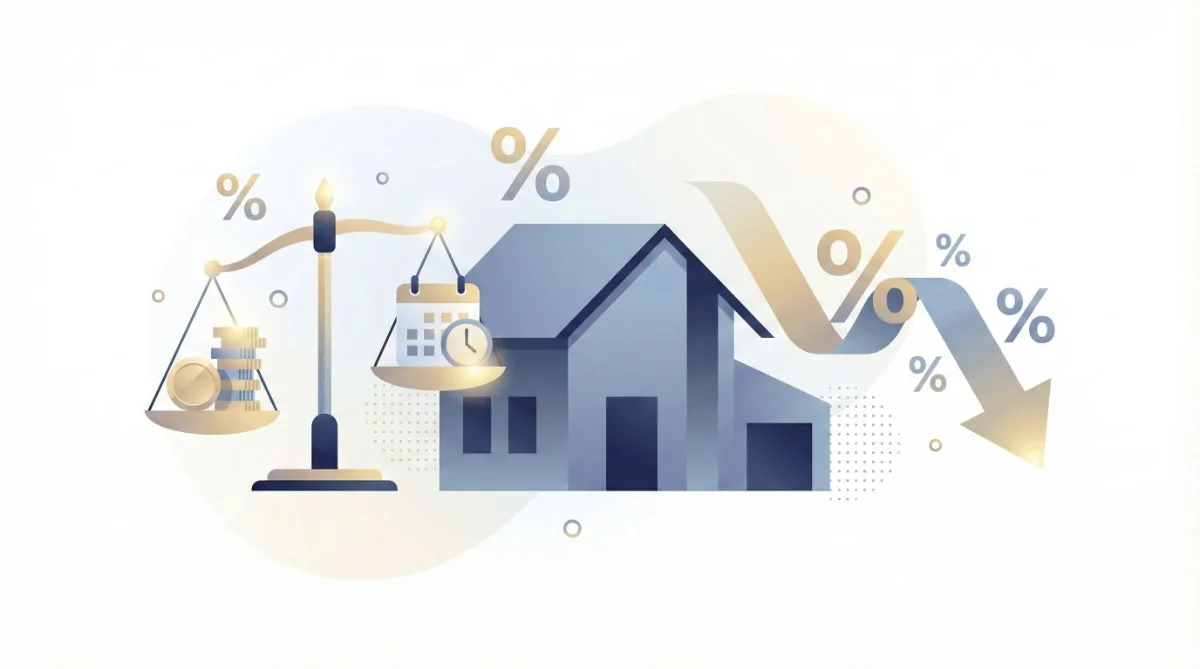
Mortgage points—often called discount points—are upfront fees you pay at closing to permanently reduce your loan's interest rate. Each point costs 1% of your loan amount and typically lowers your rate by 0.25 percentage points. Whether buying points saves you money depends entirely on how long you keep your mortgage before selling or refinancing. Calculate your break-even timeline: divide the cost of points by your monthly savings. If you'll own the home well beyond that break-even date, points can save tens of thousands in interest. If you might move sooner, that upfront cash is better spent elsewhere.
What Are Mortgage Points?
Mortgage points represent prepaid interest—you're essentially paying interest upfront in exchange for a lower rate throughout your loan term. The Consumer Financial Protection Bureau (CFPB) explains it this way: "Points let you make a tradeoff between your upfront costs and your monthly payment. By paying points, you pay more up front, but you receive a lower interest rate and therefore pay less over time."
Points are always quoted as a percentage of your total loan amount, not the home's purchase price. You can purchase whole points or fractional amounts (like 0.5 points or 1.375 points) depending on your lender's offerings and your budget.
Quick Math: On a $400,000 mortgage, one point costs $4,000. On a $300,000 mortgage, one point costs $3,000. The cost scales directly with your loan amount.
Points appear on your Loan Estimate and Closing Disclosure as part of your closing costs. You'll find them on Page 2, Section A under "Origination Charges." By law, any points listed on these documents must be connected to a discounted interest rate—lenders cannot charge points without providing a rate reduction.
How Discount Points Lower Your Rate
The standard industry formula is straightforward: one discount point equals 1% of your loan amount and typically reduces your interest rate by 0.25 percentage points (one-quarter of a percent). However, according to Bankrate's mortgage analysis, the actual reduction can range from 0.125% to 0.25% depending on the lender and current market conditions.
Here's how points affect your costs on a $400,000, 30-year fixed mortgage:
| Points Purchased | Upfront Cost | Interest Rate | Monthly P&I Payment | Total Interest Over 30 Years |
|---|---|---|---|---|
| 0 points | $0 | 7.00% | $2,661 | $558,036 |
| 1 point | $4,000 | 6.75% | $2,594 | $533,981 |
| 2 points | $8,000 | 6.50% | $2,528 | $510,178 |
With two points, you'd pay $8,000 upfront but save $47,858 in interest over the loan's lifetime. That's a significant return—if you keep the mortgage long enough to realize those savings.
The relationship between mortgage rates and points isn't always linear. Some lenders offer diminishing returns after a certain number of points, while others may provide tiered pricing. Always request a detailed breakdown showing exactly how much each point (or fraction of a point) reduces your rate.
The Break-Even Calculation: When Points Pay Off
The break-even point tells you exactly how long you need to keep your mortgage before points become profitable. The formula is simple:
Break-Even Period = Cost of Points ÷ Monthly Payment Savings
Let's work through a real example with a $350,000 loan:
| Metric | Without Points | With 1.5 Points |
|---|---|---|
| Loan Amount | $350,000 | $350,000 |
| Point Cost | $0 | $5,250 |
| Interest Rate | 7.00% | 6.625% |
| Monthly P&I | $2,329 | $2,241 |
| Monthly Savings | — | $88 |
| Break-Even | — | 60 months (5 years) |
In this scenario, you'd need to keep the mortgage for at least 5 years before the upfront point cost pays for itself. Every month beyond year five represents pure savings.
Market Reality Check: In today's elevated rate and home price environment, break-even periods often stretch to 5-7 years. Before committing to points, honestly assess whether you'll stay in the home—without refinancing—past your break-even date.
Several factors affect your break-even timeline:
- Higher interest rate environments create larger monthly savings, accelerating break-even
- Higher loan amounts mean higher point costs but proportionally larger monthly savings
- Lender pricing variations can significantly impact how much rate reduction you receive per point
- Potential refinancing resets the clock—if rates drop and you refinance before break-even, you've lost money on points
Discount Points vs. Origination Points: A Critical Distinction
Many homebuyers confuse discount points with origination points. These are fundamentally different charges, and understanding the distinction protects you from paying unnecessary fees.
| Feature | Discount Points | Origination Points |
|---|---|---|
| Purpose | Reduce your interest rate | Cover lender's processing costs |
| Benefit to You | Lower payments, less total interest | None (pure expense) |
| Tax Deductible? | Generally yes | Generally no |
| Optional? | Completely optional | Usually required (may negotiate) |
| Also Called | "Buying down the rate" | "Loan origination fee" |
Investopedia's mortgage guide emphasizes this distinction: "Discount points and origination points are not the same. Origination points are fees that lenders charge for finalizing a mortgage—part of the closing costs on a home purchase. Origination points essentially are a surcharge that doesn't relate to the interest rate."
When comparing loan offers, ensure you're comparing apples to apples. Ask each lender to quote the same scenario—either with identical points or with zero points—so you can accurately evaluate their rates and fees.
Permanent Buydowns vs. Temporary Buydowns
When you purchase discount points, you're creating a permanent buydown—your reduced rate lasts the entire loan term. However, you may encounter temporary buydown offers, particularly from builders or sellers trying to sweeten deals.
Permanent Buydown (Discount Points)
- Rate reduction lasts for the full 15, 20, or 30-year loan term
- You pay the points at closing
- Benefits compound over time as you save month after month
- Ideal for buyers planning long-term ownership
Temporary Buydowns (3-2-1 or 2-1 Buydowns)
Temporary buydowns reduce your rate for only the first few years of the loan. The most common structure is the 3-2-1 buydown:
| Year | Rate Reduction Below Note Rate |
|---|---|
| Year 1 | 3 percentage points lower |
| Year 2 | 2 percentage points lower |
| Year 3 | 1 percentage point lower |
| Year 4+ | Full note rate applies |
These buydowns are typically paid by the seller, builder, or lender as a promotion—not by the buyer. They help borrowers qualify for loans by reducing initial payments but don't provide long-term savings like permanent discount points.
Negotiation Opportunity: If a seller is offering a temporary buydown, ask whether they'd instead contribute that money toward permanent discount points or your closing costs. Depending on your timeline, one option may benefit you more than the other.
When Buying Points Makes Financial Sense
Discount points work best under specific circumstances. Consider buying points if you meet most of these criteria:
You plan to stay for 7+ years. Homebuyers who exceed their break-even period by several years maximize point savings. If you're purchasing your "forever home" or plan to raise a family there, points become increasingly attractive.
You won't refinance soon. Points only pay off if you keep your current mortgage. If rates are likely to drop significantly—making refinancing appealing—you may not reach break-even before refinancing resets your loan.
You have cash beyond essential needs. Points require upfront cash that won't go toward your down payment, emergency fund, or immediate home repairs. Only buy points with "extra" funds you can afford to tie up long-term.
You're getting a fixed-rate, long-term mortgage. Investopedia notes: "Points work well for fixed-rate, long-term mortgages (20 to 30 years) that probably won't be refinanced soon." The longer your loan term, the more time you have to benefit from reduced interest.
You value payment predictability. Locking in the lowest possible rate provides peace of mind, especially in uncertain economic environments.
When You Should Skip Points
Points aren't universally beneficial. Avoid them if any of these apply:
Your ownership timeline is uncertain. Job relocations, growing families, or lifestyle changes could trigger a move before you reach break-even. If there's meaningful uncertainty, points represent risk.
Interest rates are trending downward. When rates are declining, you may want flexibility to refinance into an even lower rate. Points paid on a loan you refinance in three years are mostly wasted.
Cash is tight at closing. Your emergency fund matters more than a marginally lower rate. Don't stretch yourself thin to buy points when that money could serve as a financial cushion.
You have a short loan term. On a 10 or 15-year mortgage, you have less time to accumulate savings, and the break-even math becomes less favorable.
You're choosing an adjustable-rate mortgage (ARM). Since ARM rates change after the initial period, paying points for a rate that will adjust anyway provides limited value.
Jeff Ostrowski, housing analyst at Bankrate, offers a candid assessment: "I'm ambivalent about paying points. It strikes me as a lot of extra analysis without a big reward." For many borrowers, putting that cash toward a larger down payment, emergency reserves, or home improvements generates better returns.
Lender Credits: The Opposite of Points
If discount points let you pay more upfront for a lower rate, lender credits work in reverse—you accept a higher interest rate in exchange for cash toward closing costs.
Lender credits appear as "negative points" on your loan documents. For example, -0.5 points on a $300,000 loan means you receive $1,500 toward closing costs while accepting a slightly higher rate.
Here's how the CFPB illustrates the tradeoff on a $180,000 loan:
| Interest Rate | Points | Upfront Cost Impact | Monthly Payment Change |
|---|---|---|---|
| 4.875% | +0.375 | Pay $675 more | Save $14/month |
| 5.000% | 0 | Standard | Standard |
| 5.125% | -0.375 | Receive $675 credit | Pay $14 more/month |
Lender credits make sense when:
- You're cash-constrained and need help covering closing costs
- You expect to sell or refinance within 5 years
- You'd rather invest extra cash elsewhere than tie it up in a slightly lower rate
Think of it as the inverse break-even calculation: how long before the higher monthly payments exceed the credit you received? If you plan to move before that point, lender credits save money.
Tax Deductibility of Mortgage Points
Points you pay to reduce your mortgage rate are considered prepaid interest and are generally tax-deductible. IRS Publication 936 outlines the rules:
For home purchases, you may be able to deduct points fully in the year you paid them if certain conditions are met:
- The loan is secured by your main home
- Charging points is an established practice in your area
- The points aren't excessive for your area
- You provided funds at or before closing at least equal to the points charged
- Points are clearly itemized on your closing statement
For refinances, points generally must be deducted ratably over the life of the loan rather than all at once. If you refinance a 30-year mortgage with $3,000 in points, you'd deduct $100 per year for 30 years.
Important Distinction: Only discount points are typically tax-deductible. Origination points (processing fees) are generally not deductible because they don't represent prepaid interest. Always consult a tax professional about your specific situation.
Where to Find Points on Your Loan Documents
Understanding where points appear on official documents helps you verify you're getting what was quoted:
Loan Estimate (before closing):
- Discount points: Page 2, Section A ("Origination Charges")
- Lender credits: Page 2, Section J (shown as negative amount)
Closing Disclosure (at closing):
- Same locations as Loan Estimate
- Compare carefully to ensure numbers match what you agreed to
The CFPB notes: "By law, points listed on your Loan Estimate and on your Closing Disclosure must be connected to a discounted interest rate." If you see points charged without a corresponding rate reduction, question your lender immediately.
When shopping for mortgages, request that all lenders quote the same point scenario—either zero points or an identical number of points—so you can make true rate comparisons.
Making Your Decision: A Practical Framework
Before deciding on points, work through this decision process:
- Calculate your break-even period using the formula above
- Honestly assess your ownership timeline—when might you sell, move, or refinance?
- Compare break-even to timeline—if break-even is 4 years and you plan to stay 10+ years, points likely make sense
- Consider opportunity costs—could that cash serve you better elsewhere?
- Factor in uncertainty—life changes; add a buffer to your break-even estimate
Many lenders and financial websites offer mortgage points calculators that can run these numbers for various scenarios. Use them to model different outcomes before committing. According to NerdWallet, comparing multiple scenarios helps borrowers make informed decisions.
Conclusion
Mortgage points offer a straightforward trade: pay more now to pay less later. The math works beautifully for long-term homeowners with stable plans and available cash. It falls apart for those with shorter timelines, refinancing likelihood, or better uses for their money.
Calculate your break-even point, compare it honestly to your expected ownership period, and remember that "right" answer varies by borrower. For first-time homebuyers planning to stay put for a decade or more, points can generate substantial savings. For those with uncertain timelines, that cash often works harder elsewhere.
One mortgage point always equals 1% of your total loan amount. On a $300,000 mortgage, one point costs $3,000. On a $450,000 mortgage, one point costs $4,500. The cost scales directly with your loan size, not your home's purchase price or your down payment amount.
One point typically reduces your interest rate by 0.25 percentage points (one-quarter of a percent), though this can range from 0.125% to 0.25% depending on your lender and current market conditions. Always ask your specific lender for their rate reduction per point—don't assume the standard amount applies.
Discount points are generally tax-deductible because they represent prepaid mortgage interest. For home purchases, you may deduct points fully in the year paid if certain IRS conditions are met. For refinances, points must typically be deducted over the loan's lifetime. Origination points (lender processing fees) are generally not deductible. Consult a tax professional for guidance on your specific situation.
Discount points reduce your interest rate—you're prepaying interest to lower your monthly payments. Origination points are lender fees for processing your loan—they provide no rate benefit and are simply part of your closing costs. Only discount points are generally tax-deductible. When reviewing loan offers, ensure you understand which type of points you're being quoted.
Divide the total cost of points by your monthly payment savings. For example, if you pay $4,500 for points and save $75 per month, your break-even is $4,500 ÷ $75 = 60 months (5 years). You need to keep the mortgage at least this long—without refinancing—for points to pay off. Any time beyond break-even represents pure savings.
Lender credits are the opposite of discount points. Instead of paying upfront for a lower rate, you accept a higher interest rate and receive cash toward your closing costs. They appear as "negative points" on loan documents. Lender credits benefit buyers who are cash-constrained at closing or don't plan to keep the mortgage long-term.
It depends on your specific circumstances, not market conditions alone. With elevated rates and home prices, break-even periods may stretch to 5-7 years. If you're confident you'll stay in your home and keep the mortgage beyond that timeline, points can still generate significant savings. If your plans are uncertain, preserving cash or using it for a larger down payment may be wiser.
Disclaimer: The information provided on RichCub is for educational purposes only and should not be considered financial, legal, or investment advice. We recommend consulting with a qualified financial advisor before making any financial decisions. RichCub may receive compensation through affiliate links or advertising on this site.
RichCub Editorial Team
Contributor
Reverse Mortgage Guide: How It Works, Requirements & Costs
Adjustable-Rate Mortgages (ARMs): How They Work, Pros & Cons
Related Articles
Closing Costs Explained: What Homebuyers Pay and How to Save
Learn what closing costs include, how much to expect (2-6% of loan amount), and proven strategies to reduce your expenses at closing.
Interest-Only Mortgages: How They Work, Risks & Who Should Consider One
Learn how interest-only mortgages work, their benefits and risks, qualification requirements, and whether this non-QM loan type fits your financial situation.
Mortgage Forbearance: How It Works & Your Exit Options Explained
Learn how mortgage forbearance works, eligibility requirements, credit impacts, and six exit strategies to protect your home and financial future.