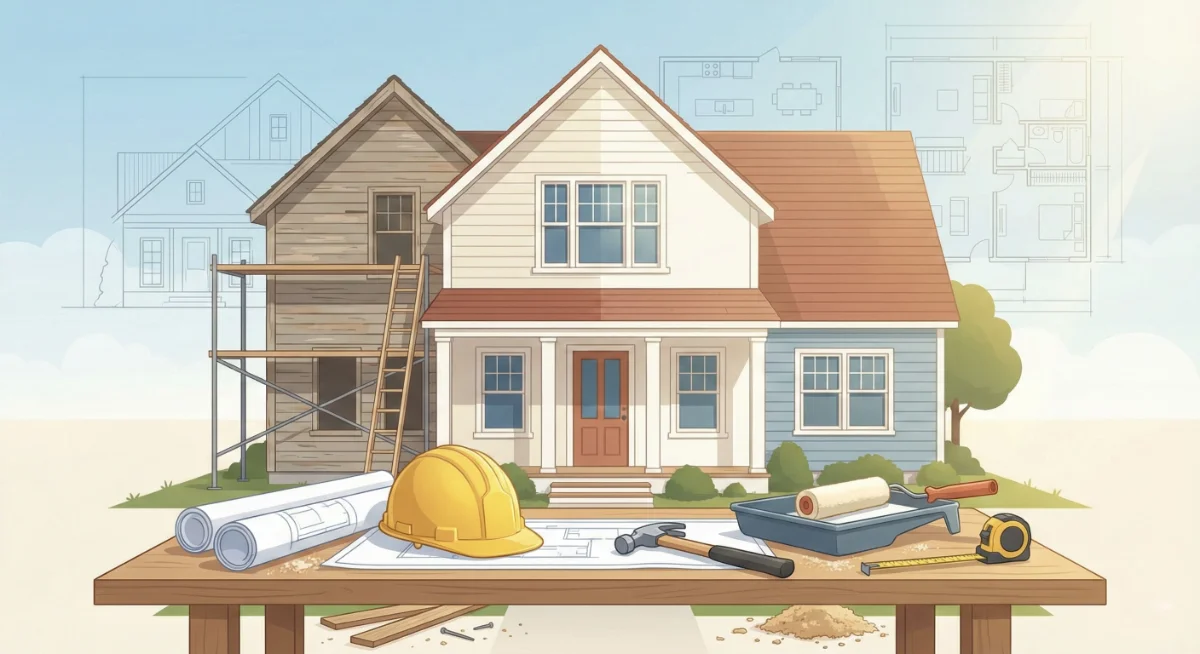
Buying a fixer-upper can be a smart financial move—you pay less upfront for a home with potential, then increase its value through renovations. But financing those improvements creates a challenge: traditional mortgages only cover the purchase price, leaving you to find separate funding for repairs. The FHA 203(k) loan solves this problem by combining your home purchase and renovation costs into a single government-insured mortgage. With down payments as low as 3.5% and credit requirements more flexible than conventional loans, this program helps buyers transform run-down properties into dream homes without juggling multiple loans. Whether you're eyeing a dated ranch that needs a kitchen overhaul or a historic property requiring structural repairs, understanding how 203(k) loans work can open doors to properties you might otherwise overlook.
What Is an FHA 203(k) Loan?
An FHA 203(k) loan is a type of government-insured mortgage that allows borrowers to finance both the purchase of a home and the cost of its rehabilitation in a single loan. Backed by the Federal Housing Administration, which is part of the U.S. Department of Housing and Urban Development (HUD), this program was designed specifically to encourage homeownership and revitalize communities by making fixer-uppers more accessible.
Unlike standard FHA loans that only cover the home's current purchase price, the 203(k) program wraps renovation costs into your mortgage. This means you close on one loan with one monthly payment, rather than taking out a separate construction loan or home equity line of credit for improvements.
The FHA doesn't lend money directly. Instead, it insures loans made by FHA-approved private lenders—banks, credit unions, and mortgage companies. This insurance protects lenders against losses if you default, which enables them to offer financing for properties that might otherwise be considered too risky.
FHA 203(k) loans aren't just for purchases. You can also use this program to refinance your existing home and finance renovations—turning your current property into the home you've always wanted without moving.
How the Financing Works
When you apply for a 203(k) loan, your borrowing power is based on the home's after-improved value—what the property will be worth once renovations are complete—rather than its current "as-is" condition. This gives you more purchasing power than loans based solely on the current market value.
Here's a simplified example:
| Scenario | Purchase-Only Loan | FHA 203(k) Loan |
|---|---|---|
| Home purchase price | $200,000 | $200,000 |
| Renovation costs | N/A | $50,000 |
| After-improved value | N/A | $280,000 |
| Total loan amount | $200,000 | $250,000 |
| Down payment (3.5%) | $7,000 | $8,750 |
The renovation funds are placed in an escrow account at closing and disbursed to contractors as work is completed, ensuring the money goes toward actual improvements.
Standard 203(k) vs Limited 203(k): Which One Do You Need?
The FHA offers two versions of the 203(k) loan, each designed for different renovation scopes. Choosing the right one depends on what work your property needs.
Limited 203(k) (Formerly Streamline 203(k))
The Limited 203(k) is designed for minor remodeling and non-structural repairs. It offers a simpler process with less paperwork but restricts the types of work you can finance.
Key features:
- Maximum renovation cost: $35,000
- No minimum renovation cost
- No structural work allowed
- HUD-approved consultant: Not required
- Completion timeline: 9 months
Eligible repairs include:
- Painting interior and exterior
- Kitchen and bathroom remodeling
- New flooring, carpet, or tile
- Roof repair or replacement
- Window and door replacements
- Well or septic system repairs
- Appliance upgrades
- HVAC repairs (non-structural)
- Accessibility improvements (grab bars, ramps)
Standard 203(k)
The Standard 203(k) handles major renovations, including structural changes. It's more complex and requires working with a HUD-approved consultant, but it accommodates nearly any repair your home might need.
Key features:
- Maximum renovation cost: Up to FHA loan limits for your area
- Minimum renovation cost: $5,000
- Structural work: Allowed
- HUD-approved consultant: Required
- Completion timeline: 6 months
Eligible repairs include:
- Everything in Limited 203(k), plus:
- Structural alterations and reconstruction
- Room additions and expansions
- Modernization of kitchen and bathrooms (gutting)
- Major plumbing and electrical replacement
- Roofing, gutters, and downspouts (full replacement)
- Elimination of health and safety hazards (lead paint, asbestos)
- Foundation repairs
- Major landscape work and site improvements
- Energy efficiency upgrades
- Converting a single-family home to multi-unit (up to 4 units)
Neither 203(k) loan allows luxury improvements. Swimming pools, tennis courts, hot tubs, gazebos, and outdoor fireplaces are not eligible. The program focuses on livability and safety improvements, not amenities.
Quick Comparison
| Feature | Limited 203(k) | Standard 203(k) |
|---|---|---|
| Max renovation amount | $35,000 | FHA loan limits |
| Min renovation amount | None | $5,000 |
| Structural changes | No | Yes |
| Room additions | No | Yes |
| HUD consultant required | No | Yes |
| Completion deadline | 9 months | 6 months |
| Number of draws | 2 (typically) | 5+ |
| Complexity | Lower | Higher |
| Best for | Cosmetic updates, minor repairs | Major rehabs, structural work |
Credit Score and Down Payment Requirements
One of the main advantages of FHA 203(k) loans is their accessibility compared to conventional renovation financing. The requirements mirror standard FHA guidelines, making this program available to borrowers who might not qualify elsewhere.
Credit Score Requirements
| Credit Score | Down Payment Required |
|---|---|
| 580 or higher | 3.5% minimum (per FHA guidelines) |
| 500-579 | 10% minimum |
| Below 500 | Not eligible |
While FHA guidelines allow scores as low as 500, individual lenders often set higher minimums. Many 203(k) lenders require a 620-640 minimum credit score. Shopping multiple lenders can help you find one willing to work with your credit profile.
If you're working to improve your score before applying, focus on the factors that matter most. Understanding how credit scores work can help you identify quick wins like paying down credit card balances or correcting errors on your credit report.
Down Payment
Your down payment is calculated on the total loan amount (purchase price plus renovation costs), not just the purchase price:
- 3.5% down with 580+ credit score
- 10% down with 500-579 credit score
Down payment sources can include:
- Personal savings
- Gift funds from family
- Down payment assistance programs
- Employer assistance programs
- Grants from nonprofits
Mortgage Insurance Premiums (MIP)
All FHA loans require mortgage insurance, regardless of your down payment size. This protects the lender if you default.
| MIP Type | Amount | Payment Method |
|---|---|---|
| Upfront MIP | 1.75% of loan amount (CFPB) | Paid at closing (can be financed) |
| Annual MIP | 0.15% - 0.75% of loan amount | Divided into monthly payments |
For most borrowers with standard loan terms, the annual MIP rate is 0.55% and remains for the life of the loan. This ongoing cost is an important factor when comparing 203(k) loans to conventional renovation options.
2025-2026 Loan Limits
FHA loan limits vary by county and are updated annually based on housing prices. These limits cap the maximum mortgage amount (purchase price plus renovation costs) you can borrow.
2025 FHA Loan Limits
| Property Type | Standard Limit | High-Cost Area Limit |
|---|---|---|
| Single-family | $524,225 | $1,209,750 |
| Duplex | $1,032,650 | $1,548,975 |
| Triplex | $1,248,150 | $1,872,225 |
| Fourplex | $1,551,250 | $2,326,875 |
High-cost area limits apply to counties where median home prices exceed the standard limit. This includes much of California, Hawaii, parts of New York and Massachusetts, and other expensive markets.
To find the exact limits for your county, use HUD's FHA Mortgage Limits tool.
Your maximum 203(k) loan amount is the lesser of: (1) the after-improved value times 110%, or (2) the purchase price plus renovation costs, or (3) the FHA limit for your area. Your lender will calculate which applies to your situation.
Eligible Properties and Repairs
Not every property or renovation qualifies for 203(k) financing. Understanding these restrictions upfront helps you identify appropriate properties and plan realistic renovation scopes.
Property Requirements
| Requirement | Details |
|---|---|
| Property age | At least 1 year old |
| Property type | 1-4 unit residential |
| Occupancy | Must be borrower's primary residence |
| Condition | Must be habitable after renovation |
| Mixed-use | Allowed if primarily residential |
Eligible property types:
- Single-family homes
- Multi-family properties (2-4 units)
- Condominiums (FHA-approved)
- Manufactured homes (if permanently attached to foundation)
- Mixed-use properties (residential portion only)
Not eligible:
- Investment properties
- Second homes or vacation properties
- Cooperative housing
- Commercial properties
Eligible Repairs and Improvements
The 203(k) program is flexible about what you can repair or improve, as long as the work enhances livability, safety, or function. Repairs must be permanently affixed to the property and must increase its value.
Common eligible improvements:
- Kitchen remodels (cabinets, countertops, appliances)
- Bathroom renovations
- Flooring throughout the home
- Roof, gutters, and drainage systems
- Windows, doors, and siding
- Electrical system upgrades
- Plumbing repairs and replacement
- HVAC installation or replacement
- Foundation repairs
- Lead paint and asbestos abatement
- Accessibility modifications (ADA compliance)
- Energy-efficient upgrades (insulation, solar panels)
Ineligible improvements:
- Swimming pools
- Tennis courts
- Hot tubs and saunas
- Outdoor kitchens and bars
- Gazebos and landscaping beyond basic grading
- Any work that takes longer than six months (Standard) or nine months (Limited)
The HUD-Approved Consultant Requirement
For Standard 203(k) loans, you must work with a HUD-approved 203(k) consultant—a licensed professional who oversees your renovation from planning through completion.
What Does a 203(k) Consultant Do?
The consultant serves as your project manager and the lender's quality control:
- Initial assessment: Inspects the property and identifies necessary repairs
- Work write-up: Creates a detailed scope of work with specifications
- Cost estimates: Reviews contractor bids to verify pricing is reasonable
- Draw inspections: Visits the property to confirm work is complete before funds are released
- Final inspection: Certifies all work meets specifications before final payment
Consultant Qualifications
To be HUD-approved, consultants must be:
- State-licensed as an architect, contractor, engineer, or home inspector
- Registered with HUD
- Carry professional liability insurance
Finding a Consultant
Your lender can typically recommend approved consultants in your area. You can also search HUD's list of approved consultants or contact local FHA-approved lenders for referrals.
Consultant fees typically range from $400 to $1,000 depending on project complexity and your location. These fees can be financed into your 203(k) loan.
Even for Limited 203(k) loans where a consultant isn't required, hiring one voluntarily can help ensure your renovation stays on budget and on schedule. Consider it if you're not experienced with construction projects.
Contractor Requirements
All renovation work must be performed by licensed contractors who meet FHA requirements. This ensures quality work and protects your investment.
Contractor Qualifications
| Requirement | Details |
|---|---|
| License | Must hold valid state/local contractor license |
| Insurance | Must carry liability and workers' compensation coverage |
| Experience | Should have verifiable renovation experience |
| Financial stability | Must be able to start work before receiving draws |
Can You Do the Work Yourself?
FHA rules allow homeowners to act as their own general contractor if they have verifiable construction experience and their lender approves. However, you cannot pay yourself for labor—only materials and work performed by licensed subcontractors can be reimbursed.
Getting Contractor Bids
You'll need detailed bids from licensed contractors before approval. Each bid should include itemized work, material specs, labor costs, timeline, and contractor credentials.
The FHA 203(k) Renovation Process and Timeline
The 203(k) process takes longer than a standard home purchase—typically 45 to 60 days from application to closing, plus renovation time. Understanding each step helps you plan accordingly.
Step-by-Step Process
Step 1: Get pre-approved (1-2 weeks)
Start by getting pre-approved for a mortgage. Work with an FHA-approved lender who has 203(k) experience.
Step 2: Find your property (varies)
Search for properties that fit your budget (purchase price plus expected renovation costs). If you're a first-time homebuyer, leave room in your budget for unexpected issues.
Step 3: Make an offer (1-2 weeks)
Submit an offer with a financing contingency specifying FHA 203(k) financing.
Step 4: Choose your consultant (Standard 203(k) only) (1 week)
Your consultant will inspect the property and create the work write-up detailing all necessary repairs and estimated costs.
Step 5: Get contractor bids (2-3 weeks)
Obtain detailed bids from licensed contractors. Your consultant (if applicable) reviews these for accuracy.
Step 6: Complete loan application (1-2 weeks)
Submit your full application with income documentation, asset statements, property information, and contractor bids.
Step 7: Appraisal (1-2 weeks)
An FHA-approved appraiser evaluates the property based on its after-improved value—what it will be worth once renovations are complete. Understand how home appraisals work to prepare. This determines your maximum loan amount.
Step 8: Underwriting and approval (2-3 weeks)
The lender's underwriting team reviews everything and issues final approval (or requests additional documentation).
Step 9: Closing (1 week)
You close on the loan, taking ownership of the property. Renovation funds go into an escrow account managed by the lender. Learn more about how closing costs work before this stage.
Step 10: Renovation (6-9 months max)
Work begins immediately after closing. Contractors are paid through a draw system—funds are released from escrow as work milestones are completed and inspected.
Step 11: Final inspection and completion
Once all work is finished, a final inspection confirms everything meets the original specifications. Schedule a home inspection to verify quality. Any remaining escrow funds are released or applied to your loan balance.
Renovation Timeline Requirements
| Loan Type | Maximum Renovation Time |
|---|---|
| Standard 203(k) | 6 months |
| Limited 203(k) | 9 months |
Missing these deadlines can create problems, including fees or loan default.
You may not be able to live in the property during major renovations. FHA 203(k) loans allow you to finance up to 6 months of mortgage payments if the property is uninhabitable during construction.
Pros and Cons of FHA 203(k) Loans
Like any mortgage product, 203(k) loans have trade-offs. Weigh these carefully against your alternatives.
Advantages
| Benefit | Why It Matters |
|---|---|
| Single loan for purchase and renovation | One closing, one monthly payment, simpler paperwork |
| Low down payment | Only 3.5% with 580+ credit score |
| Flexible credit requirements | Scores as low as 500 can qualify |
| Based on after-improved value | More borrowing power than current-value loans |
| Government-insured | Lenders more willing to approve |
| Can refinance existing home | Use for renovations without selling |
| Finances project contingency | Up to 15-20% cushion for unexpected costs |
Disadvantages
| Drawback | Impact |
|---|---|
| Mortgage insurance required | Adds 0.55% annually |
| Primary residence only | Can't use for investments |
| Longer process | 45-60+ days vs 30-45 conventional |
| Strict timeline | 6-9 months to complete |
| Consultant required (Standard) | Adds $400-$1,000 |
Alternatives to FHA 203(k) Loans
Depending on your credit profile, down payment, and renovation scope, other options might work better for your situation.
Fannie Mae HomeStyle Renovation Loan
- Minimum credit score: 620
- Down payment: 3% (conventional)
- Renovation limit: Up to 75% of after-improved value
- Luxury items: Allowed (pools, outdoor kitchens)
Best for: Good credit borrowers who want luxury improvements.
Freddie Mac CHOICERenovation
- Minimum credit score: 660
- Renovation limit: Up to 75% of after-improved value
Freddie Mac CHOICEReno eXPress
- For smaller improvements: 10-15% of home value
- Minimum credit score: 660
- **Simpler process than full CHOICERenovation
VA Renovation Loan
- Eligibility: Veterans, active military, eligible spouses
- Down payment: None required
- No mortgage insurance
- Best for: Eligible service members and veterans
USDA Renovation Loan
- Location: Rural areas only
- Income limits: Apply
- Renovation cap: $35,000
- No down payment required
- Best for: Lower-income buyers in rural areas
Home Equity Options (For Current Homeowners)
If you already own your home and want to renovate, consider:
- Home equity loan: Fixed-rate lump sum
- HELOC: Variable-rate line of credit
- Cash-out refinance: Replace existing mortgage with larger one
These options often have faster closing times and fewer restrictions than 203(k) loans.
How to Apply for an FHA 203(k) Loan
Before You Apply
- Check your credit score - Know where you stand
- Calculate your budget - Purchase price + renovation costs + 10-20% contingency
- Find an FHA 203(k) lender - Not all lenders offer these loans
Application Documents Needed
| Document Type | Specific Items |
|---|---|
| Identity | Driver's license, Social Security card |
| Income | Pay stubs (2 months), W-2s (2 years), tax returns |
| Assets | Bank statements (2 months), investment accounts |
| Property | Purchase contract, contractor bids |
Finding the Right Lender
Not all FHA-approved lenders offer 203(k) loans. Ask about their 203(k) experience, average closing timeline, and specific fees. Compare at least three lenders.
You need a minimum credit score of 580 for a 3.5% down payment, or 500-579 for a 10% down payment. However, many lenders set their own minimums at 620-640, so you may need to shop around if your score is on the lower end. The higher your score, the better rates you'll receive.
It depends on the scope of work. For minor cosmetic updates (Limited 203(k)), you can often stay in the home. For major renovations that affect livability—such as kitchen gut jobs, structural work, or hazardous material removal—you'll likely need to live elsewhere. The good news: FHA 203(k) loans can finance up to six months of mortgage payments if the property is uninhabitable during construction.
From application to closing typically takes 45-60 days—longer than a standard mortgage due to the contractor bidding process, consultant requirements (for Standard 203(k)), and after-improved appraisal. After closing, you have 6 months (Standard) or 9 months (Limited) to complete renovations.
Limited 203(k) is for repairs up to $35,000 that don't involve structural changes—think cosmetic updates, new appliances, flooring, and non-structural improvements. Standard 203(k) handles major renovations with no maximum beyond FHA loan limits, including structural changes, room additions, and foundation work. Standard requires a HUD-approved consultant; Limited does not.
No. FHA 203(k) loans are only available for primary residences—the home you'll live in as your main address. You cannot use this program for rental properties, vacation homes, or house flipping. If you want to finance investment property renovations, consider conventional options like Fannie Mae HomeStyle or a hard money construction loan.
Conclusion
FHA 203(k) loans offer a practical path to homeownership for buyers willing to see potential where others see problems. By combining purchase and renovation financing into a single mortgage with accessible credit requirements, this program makes fixer-uppers feasible for borrowers who might not qualify for conventional renovation loans.
The trade-offs are real: longer timelines, more paperwork, permanent mortgage insurance, and restrictions on what you can finance. But for the right property and borrower, these disadvantages are often outweighed by the ability to create equity through improvements while enjoying low down payments and flexible credit standards.
Before committing, compare the 203(k) program against alternatives like Fannie Mae HomeStyle or Freddie Mac CHOICERenovation if you have stronger credit. And always build contingency into your renovation budget—unexpected issues are the rule, not the exception, with older homes.
Start by connecting with an experienced 203(k) lender who can evaluate your specific situation. With careful planning and the right team of professionals, you can transform that diamond in the rough into the home you've been imagining.
Disclaimer: The information provided on RichCub is for educational purposes only and should not be considered financial, legal, or investment advice. We recommend consulting with a qualified financial advisor before making any financial decisions. RichCub may receive compensation through affiliate links or advertising on this site.
RichCub Editorial Team
Contributor
Escrow Accounts Explained: How They Work and Why You Need One
HELOC Guide: How Home Equity Lines of Credit Work
Related Articles
Interest-Only Mortgages: How They Work, Risks & Who Should Consider One
Learn how interest-only mortgages work, their benefits and risks, qualification requirements, and whether this non-QM loan type fits your financial situation.
Mortgage Forbearance: How It Works & Your Exit Options Explained
Learn how mortgage forbearance works, eligibility requirements, credit impacts, and six exit strategies to protect your home and financial future.
Mortgage Rate Lock: When to Lock, Costs & Float-Down Options
Learn how mortgage rate locks protect your interest rate, when to lock in your rate, typical costs, and how float-down options work.