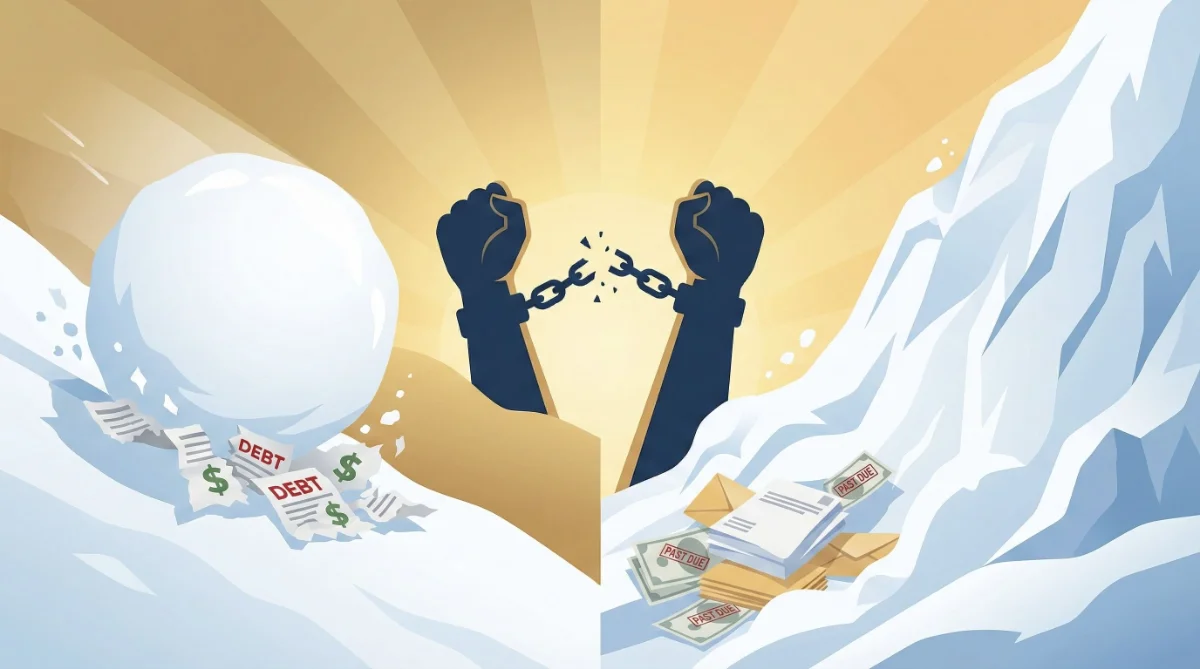
Americans carry over $5.1 trillion in consumer debt, with $1.329 trillion of that being revolving credit like credit cards, according to the Federal Reserve G.19 Consumer Credit Report. With average credit card interest rates hovering around 19.60% as of February 2026, paying off debt can feel like running on a treadmill—you're working hard but barely moving forward. The good news? Two proven strategies—the debt snowball and debt avalanche methods—have helped millions of people become debt-free. This guide breaks down both approaches, shows you exactly how each works, and helps you choose the right method for your situation.
Why You Need a Debt Payoff Strategy
Paying only minimum payments on your debt is one of the most expensive financial decisions you can make. Here's why: when you pay just the minimum on a $5,000 credit card balance at 20% APR, you'll spend approximately 23 years paying it off and shell out $7,723 in interest alone—more than the original debt, according to Bankrate's debt calculator research.
The math is working against you. Each month, your balance accrues interest—a prime example of compound interest working against you rather than for you. Your minimum payment barely covers that interest charge. Without a deliberate payoff strategy, you're essentially renting your debt indefinitely.
The Current Debt Landscape
The numbers paint a sobering picture of where Americans stand financially:
- Total consumer credit outstanding: $5.109 trillion (December 2025)
- Revolving credit (mostly credit cards): $1.329 trillion
- Average credit card APR: 19.60-22.30% depending on account type
- Americans with more credit card debt than emergency savings: 29%
Perhaps most concerning, a 2026 Bankrate survey found that only 47% of Americans could cover a $1,000 emergency expense with savings, while 24% have no emergency savings at all. This creates a cycle where unexpected expenses get charged to credit cards, adding to the debt burden.
Before aggressively paying down debt, consider building a small emergency fund of $1,000. Without this buffer, any unexpected expense could derail your debt payoff plan and force you back into borrowing.
Understanding these statistics isn't meant to discourage you—it's meant to show you that you're not alone, and that having a clear strategy is essential for breaking free from debt.
The Debt Snowball Method Explained
The debt snowball method prioritizes paying off your smallest debt balance first, regardless of interest rate. This approach was popularized by personal finance expert Dave Ramsey, who famously states that "personal finance is 80% behavior and only 20% head knowledge."
How the Snowball Method Works
The debt snowball follows a straightforward five-step process:
- List all debts from smallest to largest balance (ignore interest rates)
- Make minimum payments on every debt except the smallest one
- Throw all extra money at your smallest debt until it's paid off
- When that debt is eliminated, roll its payment into the next smallest debt
- Repeat until all debts are paid off
The method gets its name from the way your payment "snowballs"—growing larger and larger as you eliminate each debt and add its payment to the next target.
Debt Snowball Example
Consider this real-world scenario with four debts and $500 extra per month to put toward debt payoff:
| Debt | Balance | Interest Rate | Minimum Payment |
|---|---|---|---|
| Medical bill | $500 | 0% | $50 |
| Credit card | $2,500 | 22% | $63 |
| Car loan | $7,000 | 6% | $135 |
| Student loan | $10,000 | 5% | $96 |
Snowball order: Medical bill → Credit card → Car loan → Student loan
With $500 extra monthly, you'd attack the medical bill first with $550/month ($50 minimum + $500 extra). It's gone in one month. That $550 then rolls to the credit card ($550 + $63 = $613/month). The credit card is paid off in about five months.
Now you're paying $748/month toward the car loan ($613 + $135). It takes roughly nine more months to eliminate. Finally, you're throwing $844/month at the student loan ($748 + $96), wiping it out in about twelve months.
Total time to debt-free: Approximately 27 months
Why the Snowball Method Works
The power of the snowball method lies in psychology, not mathematics. Paying off that first small debt quickly creates a sense of accomplishment and momentum. You see tangible progress, which motivates you to continue.
Research from behavioral finance supports this approach. When people experience quick wins, they're more likely to persist with challenging goals. Each eliminated debt becomes fuel for tackling the next one.
Keep a visual tracker of your debt payoff progress. Seeing balances drop to zero provides powerful motivation that helps you stay committed to your debt-free journey.
Snowball Method Pros and Cons
Advantages:
- Quick wins build motivation and momentum
- Simpler to follow (just pay smallest first)
- Reduces the number of bills faster
- Higher success rate due to psychological benefits
- Works well when interest rates are similar across debts
Disadvantages:
- May pay more total interest over time
- Not mathematically optimal
- Highest-interest debt could grow while paying smaller ones
- Less effective when there's a large rate differential between debts
The Debt Avalanche Method Explained
The debt avalanche method takes the opposite approach—you target the debt with the highest interest rate first, regardless of balance. This strategy is mathematically optimal because it minimizes the total interest you pay over time.
How the Avalanche Method Works
The avalanche method also follows five steps, but with a different priority system:
- List all debts from highest to lowest interest rate
- Make minimum payments on every debt except the highest-rate one
- Direct all extra money to your highest-interest debt until it's eliminated
- Roll that payment to the debt with the next-highest rate
- Continue until all debts are paid off
According to Investopedia's analysis of the debt avalanche strategy, this method "allows you to focus on lowering the debt you have by paying less interest over time."
Debt Avalanche Example
Using the same four debts but ordering by interest rate:
| Debt | Balance | Interest Rate | Minimum Payment |
|---|---|---|---|
| Credit card | $2,500 | 22% | $63 |
| Car loan | $7,000 | 6% | $135 |
| Student loan | $10,000 | 5% | $96 |
| Medical bill | $500 | 0% | $50 |
Avalanche order: Credit card → Car loan → Student loan → Medical bill
With $500 extra monthly, you'd pay $563/month toward the credit card ($63 minimum + $500 extra). It takes about five months to eliminate. Then that $563 rolls to the car loan ($563 + $135 = $698/month), paid off in roughly eleven months.
The $698 rolls to the student loan ($698 + $96 = $794/month), eliminated in about thirteen more months. Finally, the medical bill—which you've been paying $50/month on the entire time—has been reduced to around $50 remaining and is quickly paid off.
Total time to debt-free: Approximately 24 months (slightly faster than snowball in this example)
The Mathematical Advantage
The avalanche method saves money because you're eliminating your most expensive debt first. Every dollar that goes to a 22% interest debt saves you far more than a dollar going to a 5% debt.
In the example above, the avalanche method saves approximately $50-55 in total interest compared to the snowball method. The savings can be larger when there's a bigger spread between interest rates—with some debt profiles, you might save $200-400 or more.
The interest savings from the avalanche method increase when there's a larger spread between your highest and lowest interest rates. If your rates are clustered close together, the difference between methods may be minimal.
Avalanche Method Pros and Cons
Advantages:
- Pays the least total interest
- Mathematically optimal approach
- Debt-free slightly faster in most scenarios
- Works best with large interest rate differentials
Disadvantages:
- First payoff may take longer (if highest-rate debt is large)
- Requires discipline and patience
- No quick wins to build momentum
- Higher dropout rate due to delayed gratification
Snowball vs Avalanche: Head-to-Head Comparison
Understanding the differences between these methods helps you make an informed choice. Here's a comprehensive comparison:
| Factor | Debt Snowball | Debt Avalanche |
|---|---|---|
| Priority | Smallest balance first | Highest interest rate first |
| Total interest paid | Higher | Lower (mathematically optimal) |
| Time to first payoff | Faster | Slower (usually) |
| Total payoff time | Slightly longer | Slightly shorter |
| Psychological benefit | High (quick wins) | Low (delayed gratification) |
| Complexity | Simple | Simple |
| Best for | Motivation-driven people | Discipline-driven people |
| Success rate | Higher (behavior-based) | Lower (requires patience) |
When the Difference Is Significant
The gap between methods widens under certain conditions:
Avalanche saves substantially more when:
- You have a high-interest debt (22%+) with a large balance
- There's a 10+ percentage point spread between your highest and lowest rates
- Your largest debt also has the highest interest rate
The difference is negligible when:
- Interest rates are clustered within 2-3 percentage points
- All debts are relatively small (under $5,000)
- You have only two or three debts
What the Research Says
Studies on debt repayment behavior consistently show that the snowball method has higher completion rates. People who see early progress are more likely to stay committed to their payoff plan.
However, for those who can maintain discipline, the avalanche method provides real financial benefits. The key is honest self-assessment: Which type of person are you?
Alternative Debt Payoff Strategies
While snowball and avalanche are the most popular approaches, several other strategies can accelerate your debt payoff—especially when combined with one of these core methods.
Balance Transfer Credit Cards
A balance transfer allows you to move high-interest credit card debt to a new card offering 0% APR for a promotional period, typically 15-21 months.
How it works:
- Apply for a balance transfer card (requires good credit, typically 690+)
- Transfer existing high-interest balances
- Pay no interest during the promotional period
- Focus all payments on reducing principal
Costs to consider:
- Balance transfer fees typically range from 3-5% of the transferred amount
- If you don't pay off the balance before the promo ends, rates typically jump to 20%+
Balance transfers work best when you're confident you can pay off the transferred amount before the promotional period ends. If you can't, you may end up paying more interest than before. As the Consumer Financial Protection Bureau (CFPB) warns, "taking on new debt to pay off old debt may just be kicking the can down the road."
Debt Consolidation Loans
Debt consolidation combines multiple debts into a single loan with one monthly payment, ideally at a lower interest rate than your current debts.
Benefits:
- Simplifies multiple payments into one
- May lower your overall interest rate
- Fixed payoff timeline
- Can improve credit utilization ratio
Considerations:
- Personal loan rates averaged 11.51-11.65% in 2025, according to Federal Reserve data
- Longer loan terms mean more total interest paid
- Requires discipline to avoid accumulating new debt
Home Equity Options
Homeowners may consider tapping home equity to pay off high-interest debt through a home equity loan or HELOC (Home Equity Line of Credit).
Potential benefits:
- Lower interest rates than credit cards
- Tax-deductible interest in some cases
- Larger borrowing amounts available
Critical warning: Your home serves as collateral. If you can't make payments, you risk foreclosure. The CFPB strongly cautions homeowners to consider this option carefully and only when other alternatives aren't viable.
Choosing the Right Method for You
The best debt payoff method is the one you'll actually stick with. Here's a decision framework to help you choose:
Choose the Snowball Method If:
- You need quick wins to stay motivated
- You've tried to pay off debt before but gave up
- Your interest rates are similar across debts (within 3-5 percentage points)
- You have multiple small debts that could be eliminated quickly
- Psychological momentum matters more to you than mathematical optimization
- You tend to lose focus on long-term financial goals
Choose the Avalanche Method If:
- You're highly disciplined with money
- You can delay gratification without losing motivation
- There's a significant interest rate spread between your debts (10+ points)
- Your highest-interest debt isn't also your largest debt
- You want to pay the absolute minimum in interest
- You're motivated by math and optimization
Consider a Hybrid Approach
You don't have to commit exclusively to one method. A hybrid approach combines the psychological benefits of the snowball with the mathematical advantage of the avalanche:
- Start with your smallest debt to get a quick win and build momentum
- Then switch to the avalanche method for remaining debts
- Alternatively: Pay off any debt under $500 first (regardless of rate), then switch to avalanche
This approach gives you an early victory to celebrate while still prioritizing interest savings for the bulk of your debt.
Tips for Accelerating Debt Payoff
Whichever method you choose, these strategies can help you become debt-free faster:
Increase Your Payment Amount
Finding extra money to throw at debt is the single most effective way to speed up payoff:
- Reduce discretionary spending: Temporarily cut subscription services, dining out, and entertainment
- Sell unused items: Clothes, electronics, and furniture can generate quick cash
- Take on a side hustle: Freelance work, gig economy jobs, or overtime hours
- Redirect windfalls: Tax refunds, bonuses, and gifts go straight to debt
Optimize Your Existing Payments
- Automate payments: Avoid late fees that add to your balance
- Pay more than once monthly: Bi-weekly payments reduce average daily balance and interest charges
- Round up payments: Pay $500 instead of $463—small amounts add up
- Apply raises to debt: When your income increases, increase your debt payment by the same percentage
Avoid Common Pitfalls
- Don't close paid-off credit cards if it will hurt your credit utilization ratio
- Don't take on new debt while paying off existing debt
- Don't skip your emergency fund—even $500-1,000 prevents emergencies from derailing your plan
- Don't ignore your mental health—extreme deprivation can lead to debt fatigue and spending rebounds
Building a solid financial foundation means understanding both debt management and budgeting fundamentals. These skills work together to keep you on track.
How Debt Affects Your Credit Score
Your debt directly impacts your credit score, which in turn affects your ability to borrow at favorable rates in the future.
Credit utilization—the percentage of available credit you're using—accounts for approximately 30% of your credit score. Paying down credit card balances improves your credit utilization ratio, often boosting your score within one to two billing cycles.
Payment history makes up 35% of your score. Both the snowball and avalanche methods require making minimum payments on all debts, which protects your payment history while you aggressively pay off your target debt.
As you pay off debts, you may see your credit score improve, which can qualify you for better interest rates on any remaining debt—creating a positive cycle. If you're looking to maximize this effect, check out our guide on how to improve your credit score.
Check your credit score monthly as you pay down debt. Watching your score improve provides additional motivation and helps you track the real-world impact of your efforts.
Frequently Asked Questions
The debt avalanche method saves the most money mathematically because you eliminate high-interest debt first, reducing the total interest paid over time. However, the actual savings depend on your specific debts—if your interest rates are similar, the difference may be minimal. For example, with a 20-percentage-point spread between your highest and lowest interest rates, avalanche savings could be significant. With only a 2-3 point spread, you might save less than $100 total.
The timeline depends on your interest rate and monthly payment amount. At 20% APR with only minimum payments, it could take over 10 years and cost thousands in interest. With a $500 monthly payment, you could pay off $10,000 in approximately 24 months and pay around $2,000 in interest. Using a balance transfer card with 0% APR and the same $500/month, you'd be debt-free in 20 months with minimal interest.
Financial experts generally recommend building a small emergency fund ($500-1,000) before aggressively paying down debt. Without this buffer, any unexpected expense—car repair, medical bill, appliance breakdown—could force you to take on more debt, erasing your progress. Once you have this starter emergency fund, focus intensely on debt. After becoming debt-free, build your emergency fund to cover 3-6 months of expenses.
Yes, a hybrid approach works well for many people. You might start by paying off your smallest debt to experience a quick win and build confidence. Then switch to the avalanche method for remaining debts to minimize interest. Alternatively, eliminate any debts under $500 first (for psychological momentum), then prioritize by interest rate. The best approach is one you'll actually stick with.
Paying off debt generally helps your credit score by improving your credit utilization ratio. However, there are exceptions: closing your oldest credit card after paying it off could reduce your average account age and total available credit, both of which can temporarily lower your score. Keep old accounts open (even with zero balance) to maintain a strong credit profile. Also, paying off your only installment loan (like a car loan) may slightly reduce score diversity, but this effect is usually minor.
When income is tight, focus on small wins and consistency. The debt snowball method often works better for low-income situations because the quick psychological wins keep you motivated. Additional strategies include: negotiating lower interest rates with creditors, looking into income-driven repayment plans for student loans, seeking free credit counseling from nonprofit agencies, and finding small ways to increase income through side work. Even $25-50 extra per month toward debt makes a meaningful difference over time.
Conclusion
Both the debt snowball and debt avalanche methods have helped millions of people become debt-free. The snowball method offers psychological momentum through quick wins, while the avalanche method minimizes total interest paid through mathematical optimization.
The truth is, either method works—as long as you stick with it. For most people, the behavior change and consistency matter far more than a few hundred dollars in interest savings. As the research suggests, personal finance really is 80% behavior and 20% head knowledge.
Choose the method that aligns with your personality. If you need motivation and quick wins, start with the snowball. If you're disciplined and want to optimize every dollar, go with the avalanche. Or try a hybrid approach that gives you the best of both worlds.
Whatever you choose, the most important step is simply starting. Pick a method, make your first extra payment, and take the first step toward a debt-free future. Your future self will thank you.
Disclaimer: The information provided on RichCub is for educational purposes only and should not be considered financial, legal, or investment advice. We recommend consulting with a qualified financial advisor before making any financial decisions. RichCub may receive compensation through affiliate links or advertising on this site.
RichCub Editorial Team
Contributor
Compound Interest Explained: Formula, Calculator & Real Examples
Dollar-Cost Averaging: A Simple Strategy to Build Wealth Over Time
Related Articles
Dividend Investing for Beginners: Build Passive Income in 2026
Learn dividend investing basics to build passive income. Discover dividend yields, DRIPs, aristocrats, and tax strategies for beginners.
FIRE Movement Explained: Financial Independence, Retire Early Guide
Learn how the FIRE movement works, calculate your FIRE number, and discover strategies for achieving financial independence and early retirement.
Building Passive Income Streams: A Complete Beginner's Guide
Learn how to build passive income through dividends, REITs, and index funds. Discover capital requirements and tax strategies for beginners.